High Performing Teams: Culture, Leadership and Change Resilience
- All Teams Culture

- May 18
- 5 min read

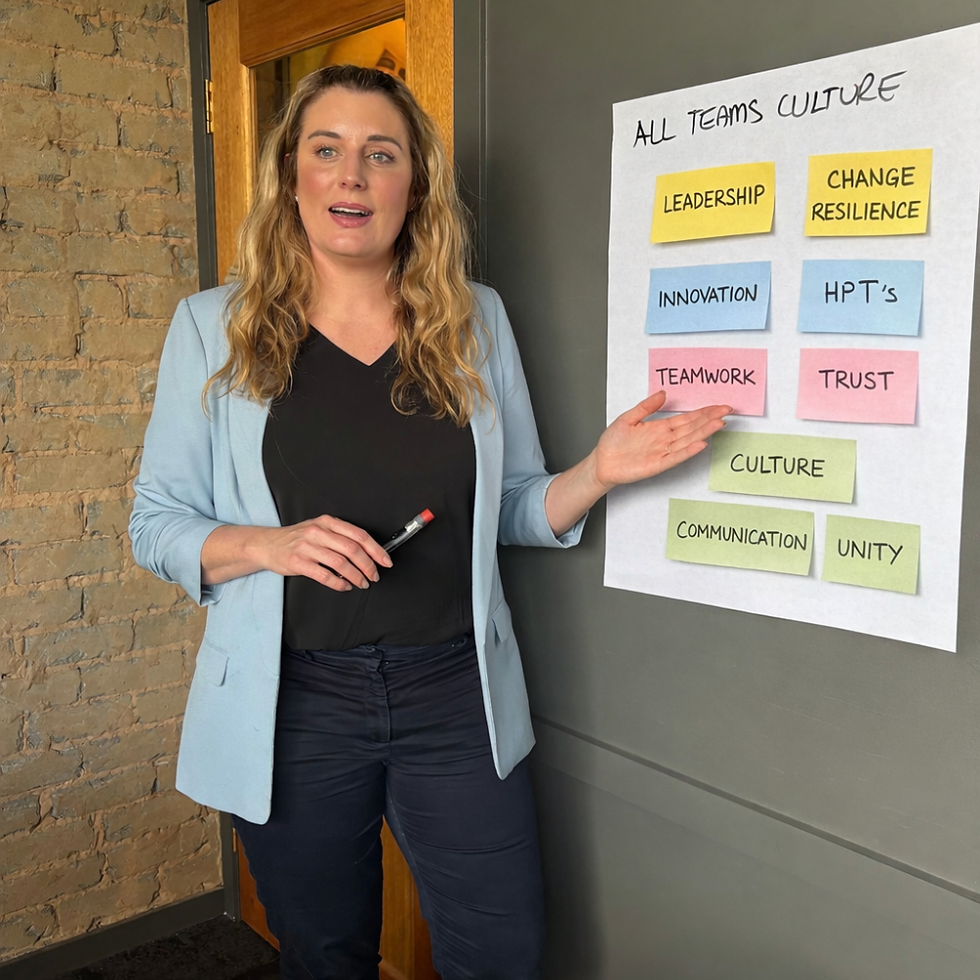
At All Teams Culture, our High Performing Teams Workshop is built around a simple premise: high performance does not sit in one place. It sits at the intersection of leadership, culture, and change resilience.
When those three elements are aligned, teams perform better. When one drops away, performance drops with it.
Before You Read the Framework
It does not have to be that complicated. You might have it in your head that this kind of work costs a lot of money and that it means a lot of training, academic jargon, personality testing, meetings, working groups. All to get a final report that just sits on a shelf- and that feels like a waste of time.
It does not have to be that way. Think about how you lead, the impact you make and how to build a team people want to be a part of. Think about how to build the kind of relationships that hold steady when change hits, so the team can absorb it, adapt, rebound, and go again.
That is the work and it is simpler than it has been made to sound. The framework below is built around it, culture, leadership, change resilience- three things, named clearly, working together as a system.
Why Culture Alone in not Enough for High Performance
Focusing on culture alone is not enough to create a high performing team. While culture plays a critical role in how teams function day to day - shaping behaviour, relationships, communication, and expectations - it does not guarantee performance on its own. A team can be positive and supportive and still struggle to deliver outcomes when leadership is unclear or if the team cannot adapt when things change.

Why High Performing Teams Matter
High performing teams matter because they deliver stronger outcomes for organisations, and a positive culture and a better work experience for the people within them. The cost of getting this wrong is now well documented for the people, both as leadership and team level, within businesses, organisations and teams.
75% of Australian employees have experienced a toxic workplace, with poor leadership identified as the primary cause.
90% of Australian workers (including leaders) experience some level of work-related distress, and 22% report it as extreme.
In 2021-22, 10,000 workplace mental health claims cost an average of $58,615 each, with people taking a median of 34 weeks off work - four times longer than physical injury claims.
Sustainable Performance Requires Rest and Recovery
One of the early ideas we challenge in the workshop is the belief that high performance means constant effort or non-stop work. Sustainable performance requires productive rest, recovery, and the ability to reset. Teams that are constantly pushed without space to recover eventually burn out or disengage, which undermines both performance and wellbeing.

High Performing Teams Framework: Three Interconnected domains
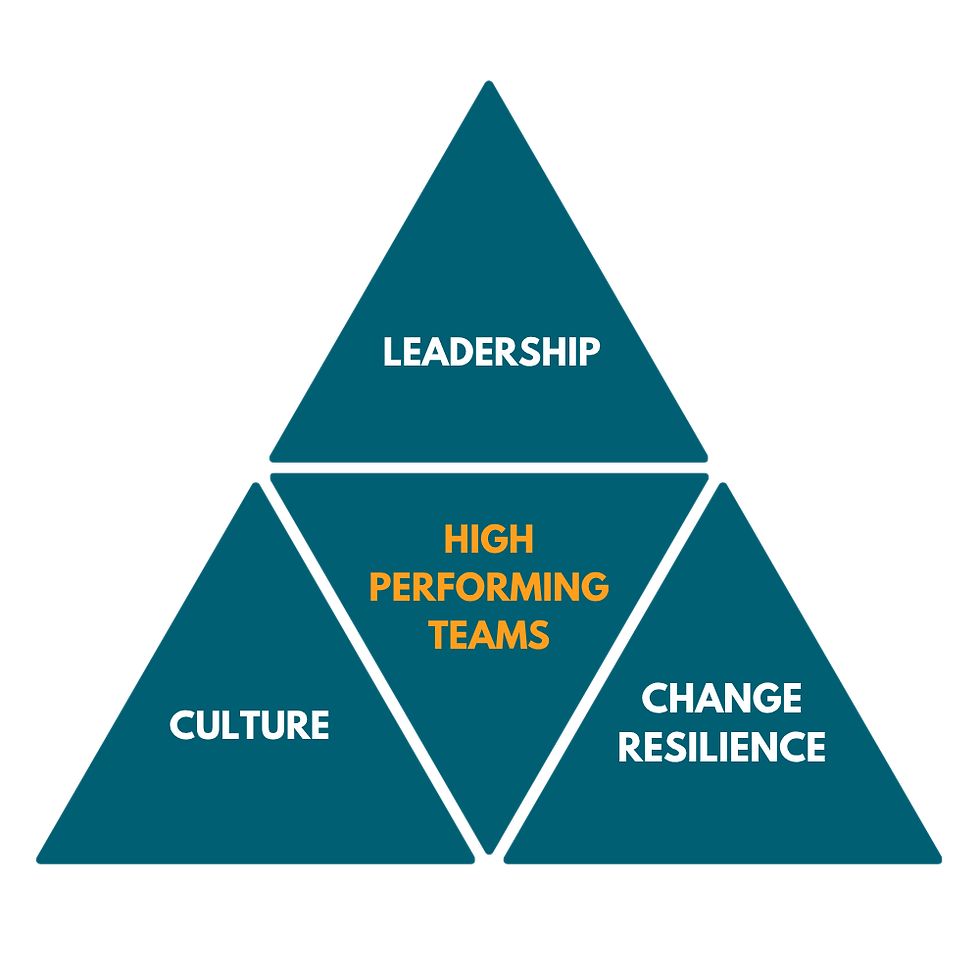
The All Teams Culture High Performing Teams Framework places the team at the centre, support by three interconnected domains:
Leadership: Clarity, Direction and Standards
Leadership provides clarity, direction, and standards. Leadership sets the tone for how work gets done, how decisions are made, and how accountability is held. Leadership is not a title - it is the behaviour that is modelled and reinforced every day. Strong leadership creates alignment and confidence, while weak or inconsistent leadership creates uncertainty that quickly erodes performance.
Culture: The Lived Experience of Your Team
Culture is the lived experience of the team. It shows up in how people treat each other, how they communicate, and what behaviours are tolerated or challenged. Culture is not values written on the wall - it is what actually happens, especially when pressure increases. For culture to support performance, it must align with leadership clarity and be reinforced consistently through behaviour and decisions.
Change Resilience: Adapting Through Disruption
Change resilience is the shared ability of a team to adapt, stabilise, and recover when change or disruption occurs. It is built through trust, communication, clarity, and consistent support. Teams with strong change resilience are better able to absorb pressure, make decisions, and move forward after setbacks, or when change is introduced to the workplace.
How Leadership, Culture and Change Resilience Work Together
High performance emerges when leadership, culture, and change resilience reinforce each other. Leadership provides direction, culture shapes behaviour, and change resilience allows teams to stay steady through challenge. When one area drops, it impacts the others and performance declines. When all three are strong and aligned, performance becomes more consistent, stable, and sustainable.

Our High Performing Teams Workshop: A Practical approach
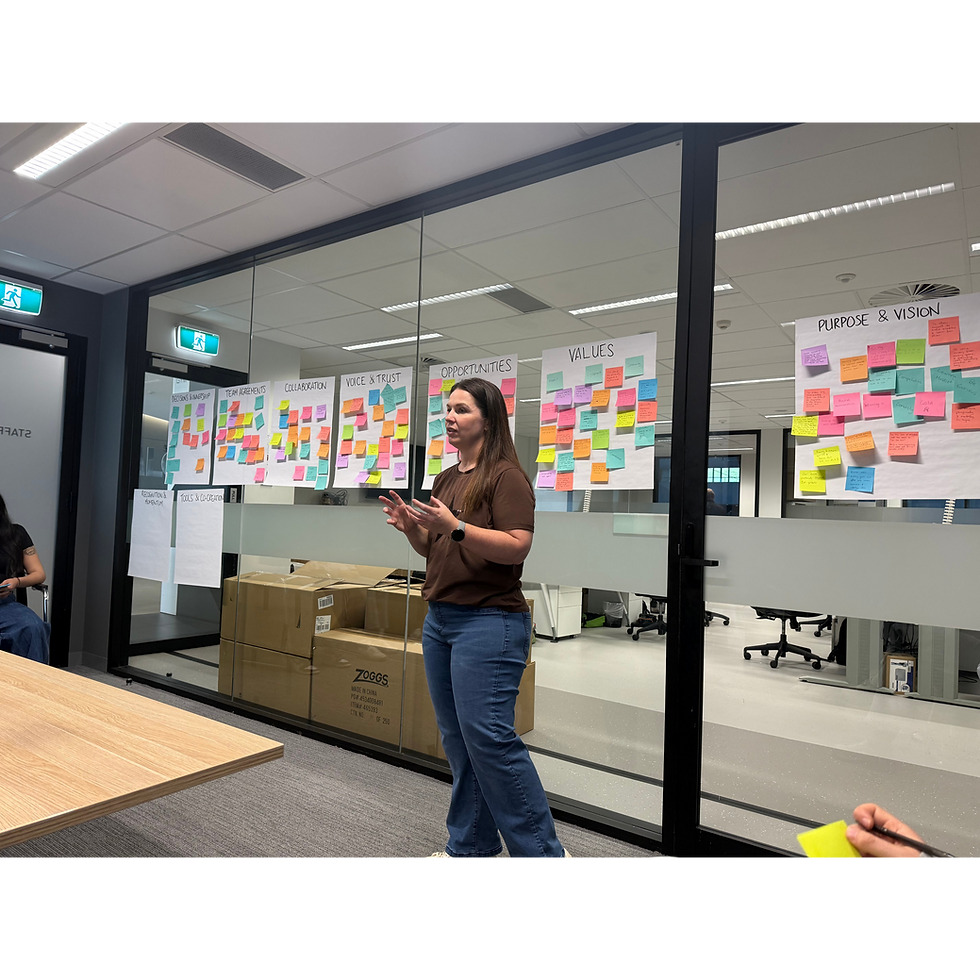
The workshop is designed to help teams explore these domains in a practical and engaging way. It creates space for reflection, discussion, and challenge, not just from facilitators but within the team itself. Teams are encouraged to think critically about what is lifting performance, what is getting in the way, and where alignment needs to be strengthened.
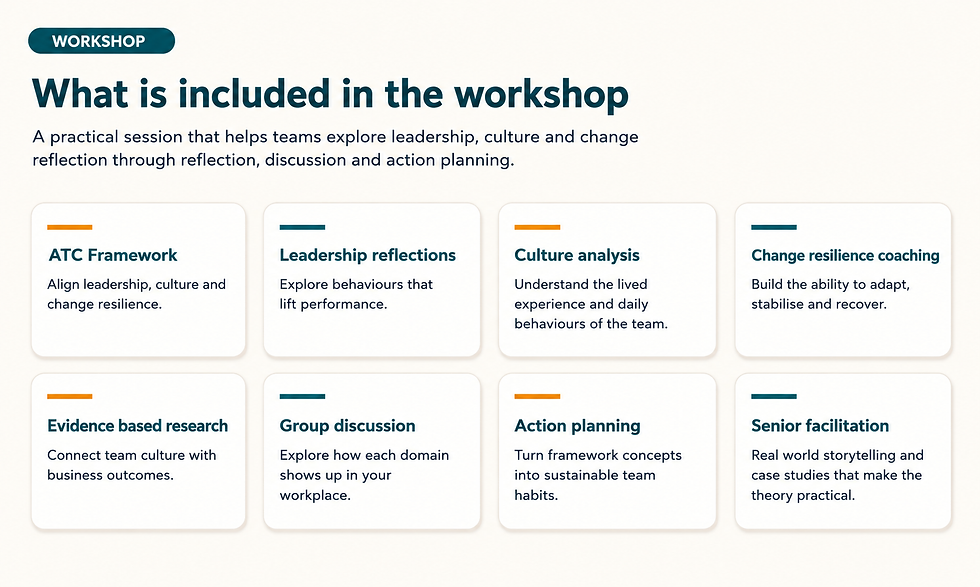
What’s included in the workshop:
The All Teams Culture Framework to align leadership, culture, and change resilience
Interactive reflections on leadership behaviours that lift performance
Culture analysis exploring the "lived experience" and daily behaviours of the team
Change resilience coaching to build the team's ability to adapt, stabilise, and recover
Evidence-based research on the link between team culture and business outcomes
Facilitated group discussions to explore how each domain shows up in your specific workplace
Action planning to turn framework concepts into sustainable team habits
Facilitation by senior advisors using real-world storytelling and case studies to make the theory practical.
What You Walk Away With
By the end of the session, teams do not walk away with motivational statements or abstract concepts. They leave with a clearer understanding of how leadership, culture, and change resilience interact in their own context, and what they need to focus on next to lift performance in a way that lasts.
Specific outcomes include:
Clarity on current team strengths and gaps
A shared understanding of performance expectations
Concrete strategies for embedding leadership consistency
Practical tools for reinforcing desired team behaviours
A roadmap for building greater change resilience.

Building High Performing Teams Take Conscious Effort
High performing teams are not built by accident - they are built through conscious effort and intentional alignment. Whether your organisation is looking to improve team productivity, strengthen leadership effectiveness, enhance cultural alignment, or build greater resilience to change, exploring these three domains together can transform how your teams perform.
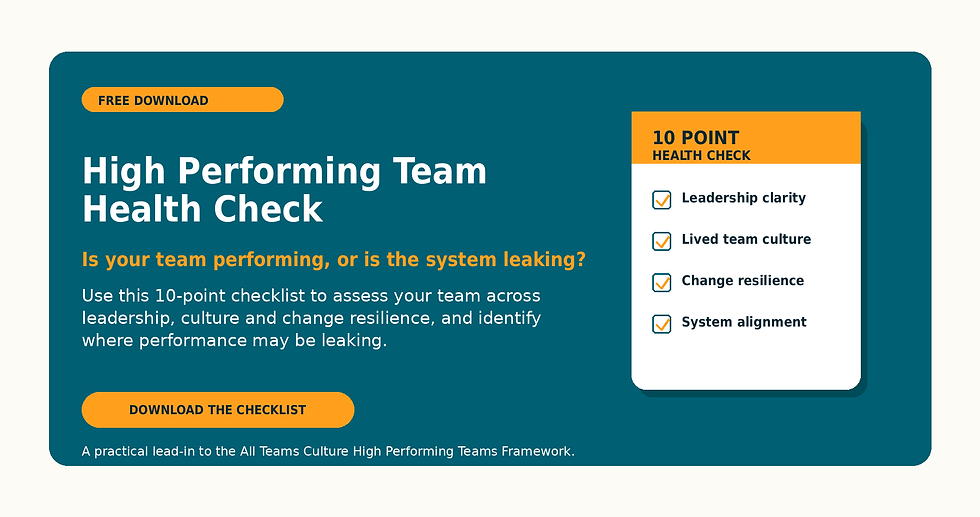
Download Our High Performing Teams Checklist
Use this 10-point checklist to assess your team across the three core domains of the All Teams Culture Framework: Leadership, Culture, and Change Resilience
Frequently Asked Questions About High Performing Teams
What Makes a High Performing Team Different?
High performing teams have three key characteristics working in concert: clear leadership that sets direction, a positive culture that reinforces desired behaviours, and the resilience to adapt when circumstances change. Most teams have one or two of these, but when all three align, performance accelerates significantly.
How Does Culture Affect Team Performance?
Culture shapes day-to-day behaviour and team dynamics. It determines how people communicate, solve problems, and support each other. When culture aligns with leadership priorities, people are motivated and engaged. When culture and leadership are misaligned, teams struggle with retention, engagement, and productivity.
How Long Does It Take to Build Change Resilience?
Change resilience is built gradually through consistent communication, clear expectations, and demonstrated support during transitions. Most teams begin to see improvements within 3-6 months of focused effort. Deeper resilience typically develops over 12 months of sustained practice and reinforcement.
Can a Disengaged Team Become High Performing?
Yes. Disengagement is typically a symptom of misalignment in one of the three domains - unclear leadership, culture that doesn't feel supportive, or low confidence in managing change. By addressing these root causes through workshops and intentional change, teams can rebuild engagement and performance.
Who Should Attend the High Performing Teams Workshop?
The workshop works best when attended by the entire team, leaders and staff together. This creates a shared understanding and commitment. Teams as small as 5 people and as large as 30 can participate effectively. For larger organisations, workshop can be run with multiple cohorts.
Comments